NOTE 01What work do
What work do
you want to repeat?
Start with contributions and ordinary responsibilities before relying on a familiar department or title.
Open the role note ↗READ THE WORK
ASK A BETTER QUESTION
WORK TAKES MANY FORMS
Laboratories, libraries, dining rooms, service desks and coordinating teams. Read the work behind the campus, then ask what the public evidence can really tell you.
Independent of Tufts University. No university affiliation, account service or official HR support.
Start with contributions and ordinary responsibilities before relying on a familiar department or title.
Open the role note ↗Keep reporting location, work pattern and service responsibilities attached to the actual assignment.
Compare campus settings ↗Separate the work, the requirements and the detail you need clarified before deciding what follows.
Read the vacancy note ↗An upcoming plan year and a departmental budgeting rate answer different questions from individual employment terms.
Label the source ↗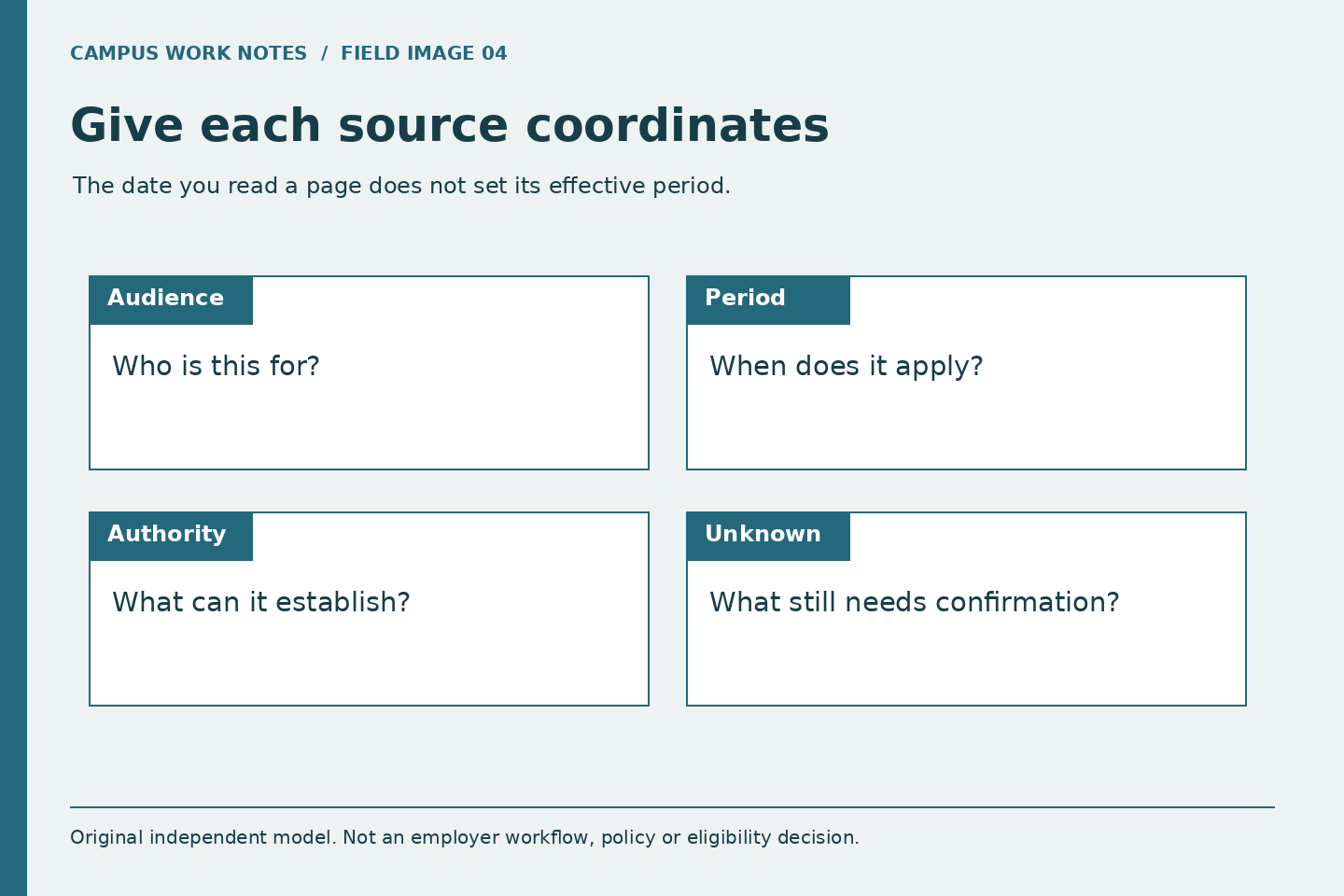
A SMALL RESEARCH HABIT
Who is the document for? When does it apply? What can it establish? What is still unknown?
Use the four questions →Campus Question Router
A vacancy, a campus arrangement and an employee record need different evidence. Select the subject and your reading situation to prepare a more precise next step.
Useful output: A contribution map with one exact assignment and two open questions.
Scope limit: No classification decision, current-opening guarantee or inferred eligibility.
Useful output: A dated document record with the applicable audience and unresolved term.
Scope limit: No pay, tax, coverage or benefit eligibility calculation.
Useful output: A work-focused proposal and a question about the official decision process.
Scope limit: No promise of remote work or approval; no private personal explanation is requested.
Useful output: A practical journey question list with location and time assumptions.
Scope limit: No live traffic prediction, parking entitlement or travel reimbursement determination.
Useful output: A small capability-practice-feedback plan.
Scope limit: No training eligibility, credit, funding or advancement promise.
Useful output: A readiness question list and verified information route.
Scope limit: No live emergency instruction, safety decision or assumption that every employee follows the same arrangement.
Useful output: A task statement and the correct kind of official question.
Scope limit: No sign-in, password recovery, employee-record access or personal HR decision.
Fixed public-source reading aid, checked October 1, 2026. Choices exist only in this page’s memory. No tool storage, cookies, uploads, URL parameters or network requests. Your browser may restore form state independently. Never enter private records or credentials.
Our eServe context note distinguishes public PeopleSoft HR information from personal record questions. The broader collection helps readers prepare for the work, compare sources and learn responsibly.
18 articles
Campus & roles
Translate the university’s many work settings into a shortlist based on tasks, evidence and the kind of day you want.
Read the article : A practical role map for work at TuftsCampus & roles
Look beyond a campus label to service hours, movement between buildings and the practical shape of an ordinary week.
Read the article : Four campus settings, many different working daysCareer preparation
A close-reading method for duties, requirements, working conditions and the evidence your application needs.
Read the article : Read a Tufts vacancy as a work specificationConditions & sources
Build a dated evidence sheet for pay, schedule, benefits and employment status before making a consequential decision.
Read the article : Compare employment terms without filling gaps with guessesConditions & sources
Use the official employee-record system with a clear question and a careful record of what you see.
Read the article : What eServe can tell you, and what still needs a conversationWorking together
Turn a new role into a manageable sequence of people, decisions and supervised practice.
Read the article : Build a first-month learning plan that goes beyond orientationConditions & sources
Discuss coverage, outputs and communication before treating a preferred schedule as a workable arrangement.
Read the article : Make a flexible-work conversation concreteConditions & sources
A practical trial that includes the last connection, schedule variation and the cost of a backup plan.
Read the article : Test the commute for the working day you will actually haveCampus & roles
Assess technical readiness, documentation habits and the boundaries of supervised laboratory work.
Read the article : Considering laboratory support? Examine the work behind the scienceCampus & roles
Look beyond a list of devices to the judgment, communication and follow-through that support work demands.
Read the article : The campus service desk: a career built on diagnosis and explanationCampus & roles
Compare user service, information organization and technical support before choosing a library role.
Read the article : Library work is more than being good with booksWorking together
A role-fit guide to operational judgment, prioritization and the information that keeps work moving.
Read the article : Facilities work: make the handoff as clear as the fixCampus & roles
Questions that separate the appeal of campus dining from the realities of the particular job.
Read the article : Investigate a dining role through service, preparation and coverageCareer preparation
Six compact stories can reveal more than a long list of skills, if each is accurate and relevant.
Read the article : Build an evidence bank before writing another applicationCareer preparation
Replace broad culture questions with concrete questions about priorities, decisions and a normal week.
Read the article : Ask interview questions that reveal the workCareer preparation
Choose one capability, one practice task and one way to check whether learning changed your work.
Read the article : Turn a training course into a useful development planWorking together
A lightweight method for remembering outcomes, changed priorities and the support you needed.
Read the article : Keep a review record that captures work, not just busynessWorking together
Clarify your assignment, communication route and practical readiness without assuming that closure means the same thing for everyone.
Read the article : Prepare for a campus disruption before the announcement arrivesCampus Work Notes is an independent publication. Public sources were checked October 1, 2026; source-check dates are not automatic effective dates. The collection was prepared with automated assistance and claims no private account testing or employee interviews.
Responsible publisher: Tom Wagner. Editorial method · Corrections