In this guide
Translate the university’s many work settings into a shortlist based on tasks, evidence and the kind of day you want.
Start with the work you want to repeat
A university career search becomes easier when you stop treating the institution as one occupation. Tufts’ official careers site describes work in administration, operations, dining and laboratories. Those areas share a mission, but they ask different things of an employee. Campus Work Notes is an independent publication: the role map below is an editorial way to compare work, not an official Tufts classification system or a list of current vacancies. Start by identifying tasks you would willingly perform on an ordinary busy Tuesday, then investigate the titles attached to those tasks.
Write down three activities that give you energy, three you can do competently, and two that you would prefer not to make central to your next role. Be specific. “Helping people” could mean explaining a form, troubleshooting a device, teaching a research method or responding to a facilities problem. “Organizing” could mean maintaining an appointment schedule or reconciling complicated project records. These differences matter more than whether an advertisement contains an attractive title. They also give you a realistic way to recognize relevant experience gained outside higher education.
Follow the work product
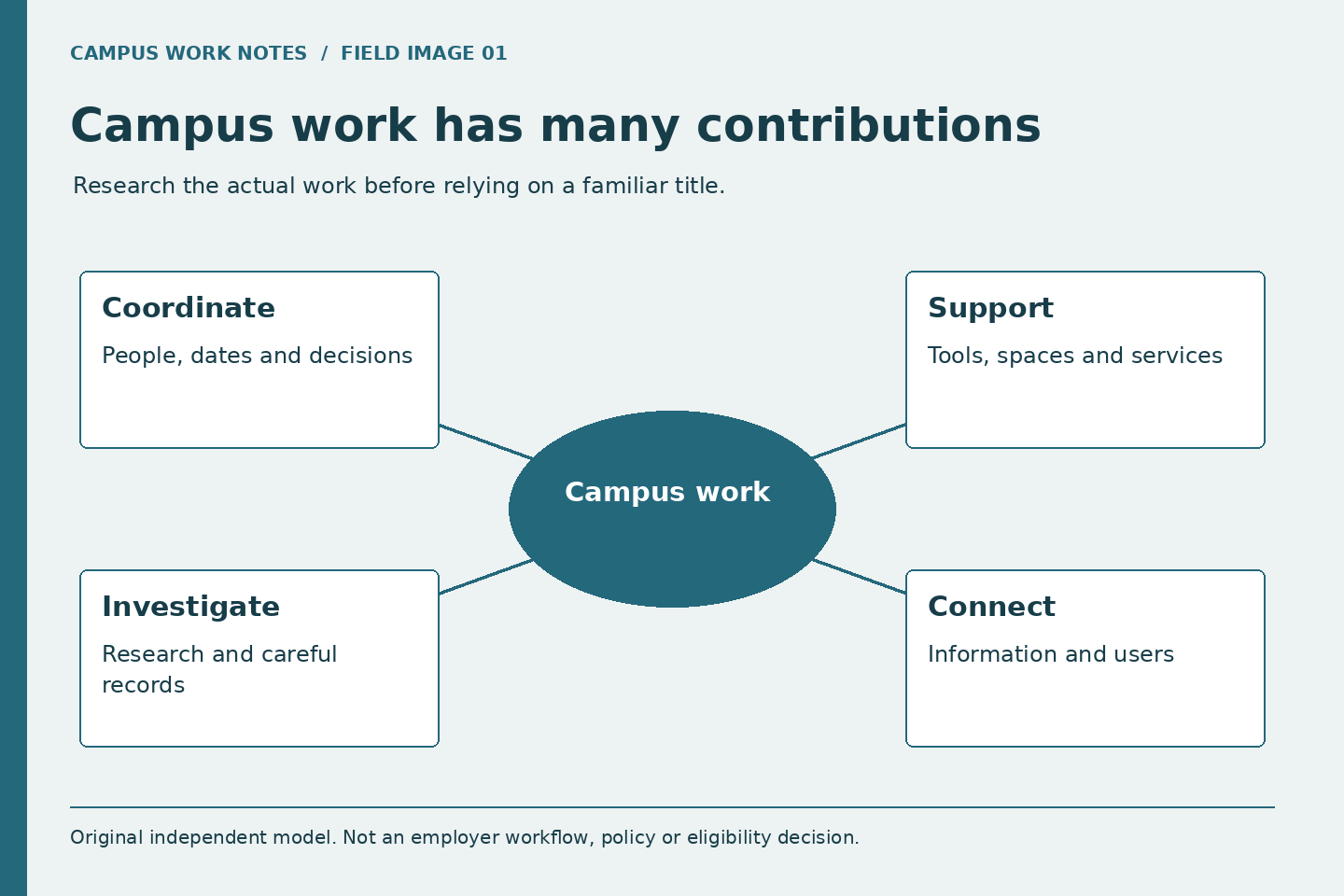
One useful family is coordination and administration. Look for the object being coordinated: a department calendar, purchasing documents, an academic program, an event or a research process. The work product might be a correct record, a completed transaction or a sequence of people arriving prepared. Your strongest evidence will explain how you kept information accurate while priorities changed. Ask whether the position primarily executes established procedures, designs new processes or advises others. All three can involve spreadsheets and meetings, but they require different levels of judgment.
A second family keeps spaces and services working. Facilities, dining, technology support and other operational roles should be investigated through reliability: what must be ready, safe or functioning, for whom, and by when? A person who enjoys visible completion may like the immediate feedback of service restoration. Another may prefer the longer horizon of planning maintenance or improving a recurring process. Do not assume that a university calendar makes every service quiet during academic breaks. Ask what the particular unit delivers throughout the year and which tasks cannot wait.
A third family supports research, learning and information. Laboratory work, library services and academic support are different occupations, yet each depends on careful interpretation of a request and reliable handling of evidence. BLS describes biological technicians as helping scientists with activities such as laboratory setup, observations and data collection. Its library-assistant profile describes patron assistance and organized access to materials. These are national occupational descriptions, useful for vocabulary rather than proof of a Tufts opening. Read the actual qualifications before choosing training or ruling yourself out.
Compare the conditions, not only the title
Create a five-line role card for each promising family. Record its typical output, the people it serves, the kind of interruption it faces, the evidence you already possess and the biggest question you still need answered. Add the actual campus and work arrangement only when an official posting or hiring contact supplies them. An administrative title does not establish remote eligibility; a technical title does not establish an on-call requirement. Keeping unknowns visible prevents a plausible guess from hardening into the basis for a career decision.
Next, separate entry requirements from development goals. A required credential or essential technical capability deserves an honest answer. A preferred software package may call for a more nuanced comparison with tools you already know. Build a two-column note: “I can demonstrate this now” and “I would need to learn or clarify this.” In the first column, name a project and your contribution. In the second, identify whether the gap is a short familiarization task, substantial training or a formal qualification. Do not present willingness to learn as existing mastery.
A hypothetical two-path comparison
Imagine a hypothetical applicant who has coordinated repair appointments and explained account problems in a community business. A service-desk role might use their patient questioning and careful case notes. An operations coordinator role might use their scheduling and follow-through. The applicant should not send an identical application to both. For the service desk, a useful example explains how they isolated a problem and checked that the person could proceed. For coordination, the same employment history might yield a stronger example about resolving a scheduling conflict before it disrupted several people.
The next step is a small investigation, not a dramatic career reinvention. Read two official postings in each relevant family when available. Highlight repeated duties and note which requirements vary. If every appealing role asks for a skill you cannot yet demonstrate, design a learning project that produces a modest, reviewable result. If the advertisements differ sharply, narrow by service context instead of accumulating unrelated certificates. The aim is to discover a credible next move, not to prove that you can do every kind of university work.
Make a shortlist you can defend
Keep a maximum of three role families in active comparison. For each, finish this sentence: “I am investigating this because I can show this capability, I want to do this kind of work, and I still need an answer about this condition.” The sentence makes your interest intelligible to both you and a hiring team. It also protects against applying solely because a recognizable institution appears in the employer field. Use Read a Tufts vacancy as a work specification to turn a specific advertisement into evidence requirements, and Four campus settings, many different working days to examine the setting behind its location label.
A sensible shortlist is provisional. New information about the actual schedule, supervision, role boundaries or employment term may change it. That is useful progress rather than a failed search. Keep the dated posting and your notes together, revisit the unknowns after an interview, and retire options that do not meet your constraints. The result should be a focused set of opportunities you understand well enough to discuss concretely, rather than a large collection of titles whose day-to-day work remains a mystery.
Use the Question Router for a bounded practice or research step.
Continue reading: Read a Tufts vacancy as a work specification, Four campus settings, many different working days, Compare employment terms without filling gaps with guesses.