In this guide
A close-reading method for duties, requirements, working conditions and the evidence your application needs.
Establish what you are reading
A vacancy is both an invitation and a compact description of a service the employer needs. Read it first as a work specification, then as an application opportunity. Start at Tufts’ official careers site and retain the exact title, requisition identifier, location and date you checked the advertisement. Campus Work Notes does not maintain a live vacancy feed. A link that appeared in search results may change or disappear, and a copied description may omit important terms. Confirm the live posting before relying on its details or submitting an application.
Separate the employer, school or unit, and work location. These fields answer different questions. A department description may explain mission and scale without saying which responsibilities belong to this job. A location label may name the administrative base without explaining attendance. Read the entire posting before treating a headline as definitive. Where the text is ambiguous, preserve the wording and turn it into a precise question. It is better to ask “Which of these duties is the main priority in the first months?” than to build an application around an unsupported guess.
Extract the verbs and their objects
Underline action words and the objects attached to them: coordinate events, reconcile records, support users, prepare materials, manage a budget. Then ask how much ownership each phrase implies. “Assist with” and “lead” can point to different expectations, but context still matters. A person may own a small process while supporting a much larger program. Group duties into three to five clusters and give each a plain-language label. If almost every bullet falls into coordination and service, a decorative mention of strategy should not dominate your application.
For each cluster, write the likely output without inventing internal metrics. A hypothetical program-coordination posting might imply a complete participant list, accurate scheduling and timely communications. You can demonstrate related capability without claiming knowledge of the unit’s private targets. Ask what good work would make possible for the next person in the chain. This reveals useful evidence: reducing missing information, identifying a conflict before a deadline or making a handover understandable. It also helps you see whether you enjoy the recurring core of the role, not just its occasional special projects.
Distinguish requirements from preferences
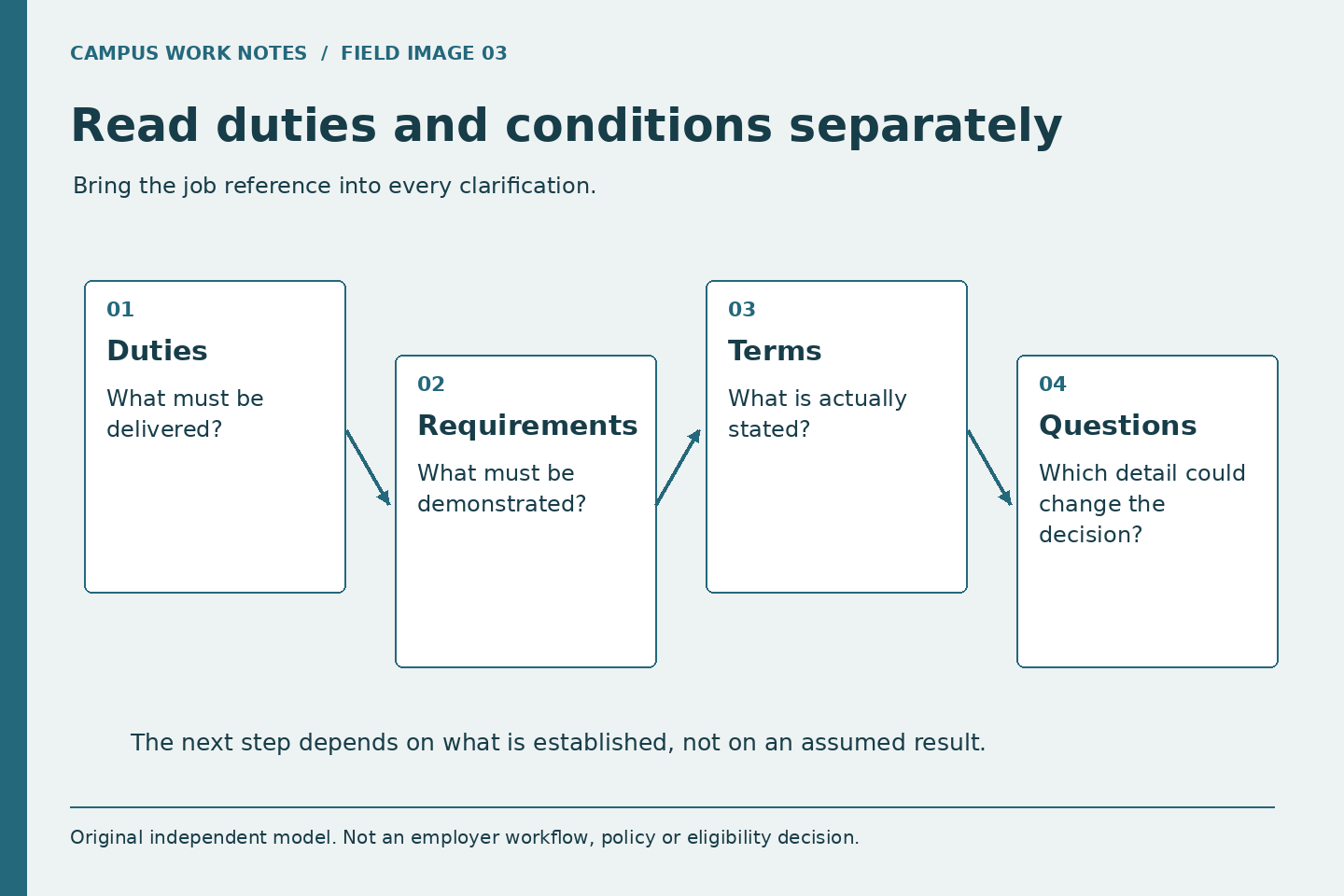
Create three headings in your notes: stated requirements, stated preferences and questions. Put formal credentials and clearly required experience in the first group. Put explicitly preferred capabilities in the second. Put unclear equivalencies, missing schedule information or unfamiliar terminology in the third. Do not silently move an inconvenient requirement into the preferences column. Equally, do not convert every desirable phrase into an absolute barrier. The employer’s wording, followed by appropriate clarification, is a better guide than generic advice that applicants should match some fixed percentage of an advertisement.
Use BLS occupational profiles as a vocabulary aid when a job family is unfamiliar. They can explain what an occupation commonly involves across the country. They cannot override the posted requirements, establish a university pay rate or tell you that a particular department will train you in a missing skill. An occupation can also contain several specialties. A computer-support profile, for example, distinguishes user support from network work. If a vacancy combines them, investigate the balance rather than assuming that experience in one proves readiness for every task in the other.
Build an evidence matrix
Make one row for each important duty cluster. In that row, record an example from your own experience, your specific contribution, an observable result and a limitation. The limitation matters: perhaps you helped with a budget but did not approve expenditure, or used a system without administering it. Honest boundaries make an application more credible. They also prepare you for follow-up questions. A hiring team can assess transferable judgment more easily when it understands what you actually did than when every sentence claims broad ownership.
Here is a hypothetical row in prose: “Coordinating competing requests: maintained a shared schedule for several service appointments, checked dependencies with colleagues, and alerted the supervisor when an urgent request displaced planned work; did not control staffing levels.” That example could support a concise application statement and a more detailed interview answer. It is not a claim about a real applicant or a Tufts hiring preference. The technique works because it links an advertised responsibility to evidence without pretending the two workplaces are identical.
Find the conditions that change the decision
Read for term, hours, attendance, physical or environmental requirements, travel, reporting relationships and any stated compensation information. Keep these conditions separate from enthusiasm about the mission. A role can be interesting and still conflict with a non-negotiable schedule or location constraint. When the advertisement does not answer an important question, do not fill the gap with a university-wide marketing statement. General descriptions of flexibility or benefits do not establish the terms for an individual position. Use Compare employment terms without filling gaps with guesses to organize the later confirmation.
Examine broad phrases such as “other duties” without treating them as evidence of either a wonderful growth opportunity or an unlimited burden. Ask how priorities are set, what recent examples of additional work have looked like and which responsibilities are central. A useful interview question is “When two deadlines compete, who decides what takes priority?” It tests the work structure without accusing anyone of poor management. Another is “What would you most want the person to understand after three months?” The answer can expose training needs and expectations that a compact advertisement cannot fully describe.
Produce a one-page application brief
Before drafting, finish a one-page brief containing the role’s apparent purpose, three strongest matches, two genuine gaps or questions, and the conditions you need to confirm. Use it to choose examples, not to manufacture keywords. Keep the application consistent with your actual experience and make specialized terminology understandable. A short, relevant statement usually carries more information than a long list of tools without context. If a requested writing sample contains confidential material from another employer, create an authorized or clearly hypothetical alternative rather than sharing protected work.
Finally, save the submitted version alongside the dated posting and note any response or follow-up deadline the process actually gives you. Do not invent an expected hiring timeline. If an advertisement changes, compare the revision before an interview. The goal of close reading is not perfect certainty; it is a better conversation based on evidence. You should be ready to explain why the work fits, where you can contribute immediately and what you need to learn, while leaving the employer room to clarify the role it is actually hiring.
Continue reading: Compare employment terms without filling gaps with guesses, Build a first-month learning plan that goes beyond orientation.