In this guide
Build a dated evidence sheet for pay, schedule, benefits and employment status before making a consequential decision.
Keep the evidence attached to the claim
An employment comparison should show what is confirmed, what is conditional and what remains unknown. A general benefits page, a vacancy and an individual offer serve different purposes. Tufts’ official Benefits pages distinguish employee audiences, while its staff compensation philosophy describes factors used in setting pay. Neither tells an independent publication what a particular reader will receive. This guide is a practical recordkeeping method, not individualized financial, legal or benefits advice. Direct questions about your own terms to the appropriate hiring or benefits contact and retain the answer.
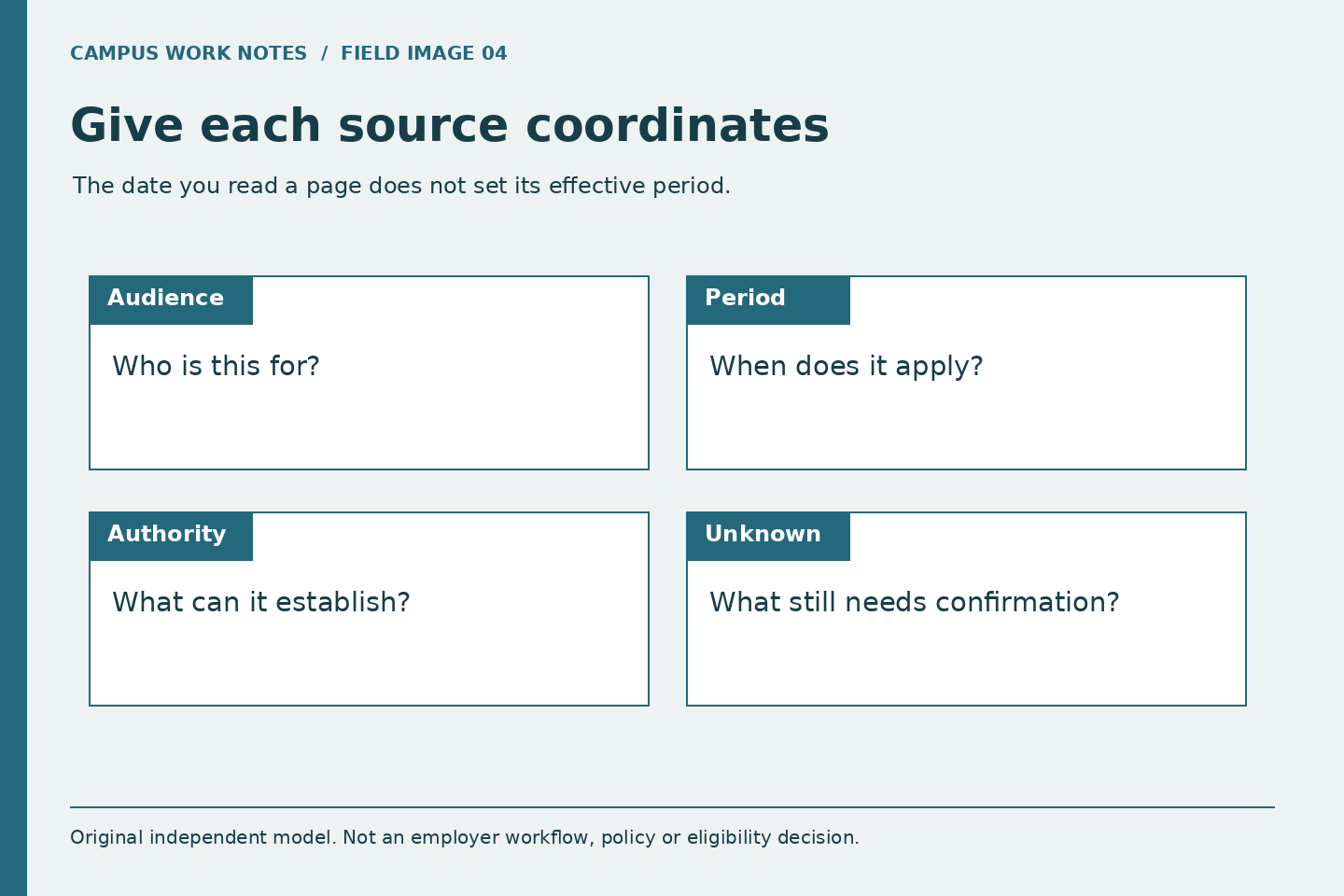
Begin an evidence sheet with the employer’s exact name, position, employee group, expected start date, hours or appointment fraction, term and work location. These details determine which questions to ask next. Do not borrow a colleague’s terms because the job titles sound similar. A staff position, postdoctoral appointment, temporary assignment and union-covered role may point to different documentation. When a policy includes an audience or effective date, copy that information into your notes. A correct statement about the wrong employee group is still a poor basis for your decision.
Compare pay using matching units
Record whether a figure is hourly, annual, a range or a proposed individual amount. Then record the hours and period to which it applies. Do not compare an annual figure for one appointment with an hourly figure for another without understanding the scheduled work and employment term. Keep possible overtime, differentials, variable awards and future increases separate from confirmed base compensation. If a figure is not guaranteed in the applicable written terms, label it as a question or possibility rather than including it in a dependable household budget.
Tufts’ staff compensation philosophy says pay decisions consider factors including relevant experience, expertise and internal equity. That explains why a published range should not be treated as a promise of its maximum. For a conversation about an offer, prepare evidence related to the role’s scope and your relevant capability. Ask how the proposed amount relates to the position and which part of the package is open to discussion. Avoid relying on a national occupational median as if it were the university’s rate. BLS data describe broad labor markets, not an individual hiring decision.
Separate the costs that look similar
Tufts’ Fringe Benefits Rates page, checked October 1, 2026, explicitly describes rates for departmental and research planning. Such a rate describes an employer-side accounting purpose; it is not, by itself, the percentage deducted from an employee’s paycheck. Do not multiply your proposed salary by a departmental fringe rate to estimate personal take-home pay. Ask for the applicable employee contribution information and the correct plan-year materials. This distinction is a reading safeguard, not a claim that any particular published rate applies to your role or that all benefit costs follow one calculation.
For personal planning, separate employee premiums, optional elections, payroll deductions and expenses paid directly outside payroll. Record the frequency of any quoted amount. A per-pay-period contribution cannot be compared with a monthly figure without knowing the schedule. Taxes depend on individual circumstances and applicable rules, so an independent editorial worksheet should leave them for an appropriate official calculator or qualified adviser. A useful comparison can still be made without pretending to know take-home pay: identify the confirmed recurring amounts and keep unresolved calculations visibly unresolved.
Read benefits by audience and year
The Tufts Benefits page checked on October 1, 2026 advertises 2027 Open Enrollment for October 26 through November 13, 2026. That is a dated announcement, not an evergreen enrollment window or proof that a specific reader is eligible. Future readers should check the current official page and the materials for their employee group. New-hire elections and changes following qualifying events have their own rules; do not assume an annual enrollment announcement answers those situations. The university’s benefits support function is the appropriate place for an individual case.
When comparing benefit information, make a separate entry for each feature important to you: coverage start, employee cost, dependent rules, time off, retirement arrangements or educational assistance. Record the source and whether confirmation is still needed. Do not attach a dollar value to a benefit you have not established you can use. For example, the value of an educational program depends on eligibility, approved study, timing and your ability to participate. Listing it as automatically equivalent to cash makes an offer comparison look more precise than the evidence allows.
Put schedule and duration beside money
Two offers with similar base pay can create very different working weeks. Record normal attendance, required availability, anticipated travel and how schedule changes are decided. Identify whether an employment term has a stated end date or funding condition and ask how that condition is communicated. Do not translate a positive conversation about future possibilities into a renewal guarantee. Likewise, a public flexible-work policy does not establish a permanent individual arrangement. Read the policy scope and confirm the actual expectation for the position through the hiring process.
A hypothetical comparison illustrates the point. One role offers a clearly documented schedule; another offers an attractive description but leaves campus attendance unresolved. Instead of awarding the second role an assumed commuting saving, put “attendance not confirmed” in the sheet. Ask the hiring contact for the expected pattern and revisit the comparison after the answer. This method does not automatically favor certainty over flexibility. It simply prevents an unknown condition from being counted as a benefit before anyone has agreed that it exists.
Close the important unknowns
Before making a consequential decision, rank remaining questions by impact. Start with the ones that could make the role impractical or change your understanding of the agreement. Send a concise list through the appropriate channel, with the relevant position identifier and the wording you need clarified. Keep personal medical, family or financial detail out of a broad email unless it is necessary for the specific process and you are using the proper recipient. A focused factual question often needs far less disclosure than a lengthy account of your circumstances.
Your finished sheet should allow another careful reader to distinguish a quoted term, an official general rule, a personal estimate and an unanswered question. Date it and revise it when written information changes. Use Four campus settings, many different working days for the practical working-week comparison and What eServe can tell you, and what still needs a conversation once employee records become relevant. The strongest decision is not the one with the most elaborate spreadsheet. It is the one whose few important assumptions have been checked, whose trade-offs are understood and whose remaining uncertainty is acknowledged before you commit.
Continue reading: Four campus settings, many different working days, What eServe can tell you, and what still needs a conversation, Make a flexible-work conversation concrete.