In this guide
Look beyond a campus label to service hours, movement between buildings and the practical shape of an ordinary week.
A location is part of the job
Tufts’ official careers material distinguishes Medford/Somerville, Boston’s Chinatown health-sciences setting, Boston Fenway and Grafton. Its community page describes teaching and research environments, creative facilities at the School of the Museum of Fine Arts, and veterinary facilities in Grafton. These facts explain why “working at Tufts” is an incomplete description of a working day. They do not tell you where a particular employee spends each hour. This guide offers an independent method for examining the physical setting after you find an actual role.
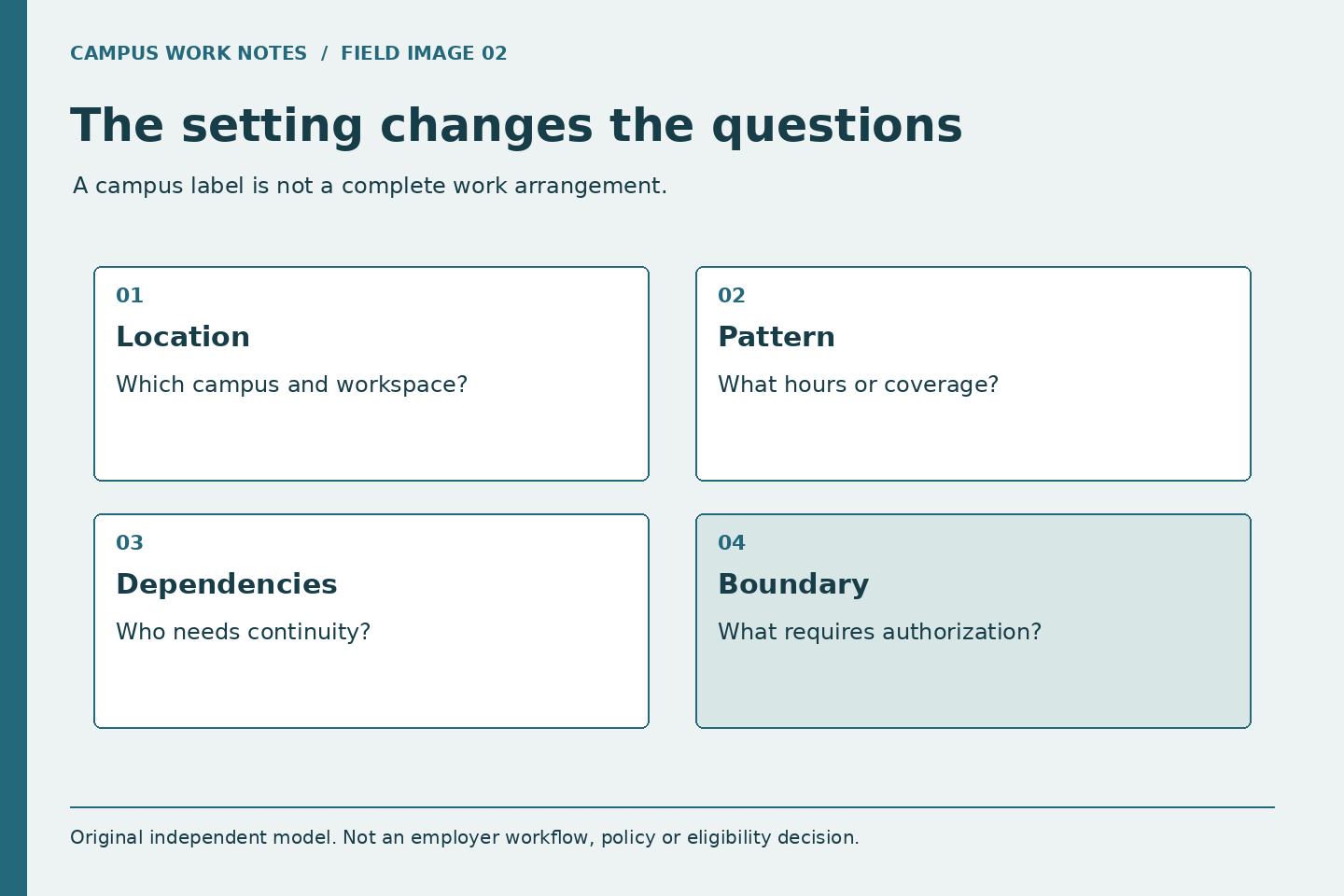
Begin with the advertised work location, then ask for the building or service area when it becomes relevant. A campus name may be sufficient for a first search filter but insufficient for a commute, accessibility plan or shift decision. Distinguish the place where the team is based from the places it serves. A central function could support people elsewhere; a role attached to one school could involve travel between buildings. Do not infer regular travel solely because a job mentions collaboration across the university. Request a concrete description of a normal week.
Medford and Somerville: ask about the service rhythm
For a role in Medford/Somerville, investigate how the work interacts with teaching, residential life, research or administration. The useful question is not whether a campus feels lively. It is which moments create demands on this particular position. A student-facing service may have predictable surges; a project team may work to construction or procurement milestones. These are possibilities to investigate, not claims about all jobs on the campus. Ask which deadlines are fixed, how coverage is arranged and what happens when several requests become urgent at once.
Walking distance is working-day information. When a role involves more than one building, ask whether movement is occasional, scheduled or a routine part of delivery. Consider what you would carry, where meetings happen and whether weather affects the journey. During a permitted visit, time the final part of the trip rather than only the ride to a transit stop. A route that appears short on a map can still require an unfamiliar entrance, a security check or additional indoor travel. Those details help you plan without assuming they are obstacles.
Boston settings: identify the actual environment
The official campus descriptions distinguish Chinatown’s health-sciences context from Fenway’s arts setting. Do not collapse them into a generic “Boston job.” When examining a Chinatown role, clarify whether the work is educational, research-focused, administrative or connected to a clinical service. The presence of health-sciences schools does not make every vacancy a patient-care role. It also does not establish employment by a separate medical organization. Confirm the employer named in the posting and offer rather than carrying benefits or policies from another similarly named institution into your comparison.
For a Fenway role, the official community page’s references to studios, workshops and production spaces suggest useful interview questions about the environment, but not automatic duties. Does the employee support a scheduled class, an open facility, equipment or a back-office process? Who decides when a space can be used? What training accompanies unfamiliar equipment or materials? An applicant should not promise to operate specialized equipment based on general enthusiasm for an arts campus. Understanding the distinction between supporting a facility and independently performing its specialist work is part of assessing fit.
Grafton: separate animal-care context from job scope
The university describes Grafton facilities that include animal hospitals, a working farm, laboratories and administrative spaces. That mix makes precise role questions particularly important. Ask whether a vacancy works directly with animals, supports the people caring for them or serves a different campus function. Confirm the training, supervision and duties in the actual position. Neither a campus photograph nor a general school description establishes what a new employee will be authorized or expected to do. Treat direct-care or technical requirements as things to verify carefully.
A Grafton commute also deserves its own test. Do not assume that a transportation option useful for a Boston appointment works equally well for a particular Grafton shift. Establish the required arrival and departure times, the final connection to the workplace and the alternatives if the main route fails. The official transportation resources are a starting point; current service information and the actual work schedule supply the decision. If occasional travel to another campus is part of the role, ask how it is scheduled and handled rather than silently absorbing it into a personal estimate.
Build a working-week sketch
Draw a simple Monday-to-Friday sketch, or the actual sequence of shifts if the job follows another pattern. Place confirmed on-site blocks, handovers, likely travel and recovery time around the edges. Mark unconfirmed information with a question mark. Add a separate line for exceptional weeks: major events, coverage during absence, seasonal activity or an emergency assignment. The sketch should not imply that the employer has agreed to your preferred pattern. Its purpose is to reveal the questions that a campus label leaves unanswered.
For a hypothetical applicant comparing a two-day campus arrangement with a fully on-site role, the number of journeys is only one variable. The two-day arrangement may require attendance on changing days; the on-site role may have more predictable start times. Neither is universally better. Compare the constraints that matter to you: notice, travel duration, service coverage, concentration time and the ability to plan commitments outside work. Ask about flexibility using the specific role’s needs, as discussed in Make a flexible-work conversation concrete, rather than assuming one arrangement across a school.
Verify before making a commitment
Before accepting a role, aim to confirm five items: the usual work address, attendance expectations, normal schedule, travel between locations and how changes are communicated. If one remains unresolved, record who will answer it and when. An interview can provide useful context, but important employment terms should be checked through the appropriate hiring process. Campus Work Notes cannot resolve a person’s accommodation, eligibility or contractual position. Those questions deserve the relevant university office and the documents that apply to that employee group.
The best campus comparison ends with a realistic picture of the week. You should be able to explain how you would arrive, what setting you would work in, whom you would serve and which conditions still need confirmation. This is more useful than ranking campuses by atmosphere alone. Pair that picture with Compare employment terms without filling gaps with guesses so the practical environment and the documented terms support the same decision, and revisit both if the role, location or working arrangement changes.
Continue reading: Make a flexible-work conversation concrete, Compare employment terms without filling gaps with guesses, Read a Tufts vacancy as a work specification.